
Secure Your Farm or Rural Property with Automated Gates and Access Control
Secure your main entrance, control vehicle access and protect the assets that keep your rural business moving.
Farms, estates, equestrian premises, agricultural dealerships and isolated rural properties can be difficult to secure. Entrances may be a long way from occupied buildings, traffic can be unpredictable and valuable machinery may need to move in and out throughout the day.
A properly specified electric gate or barrier gives you a controlled point of entry. It will not guarantee that crime never happens, but it can deter opportunist access, delay an attempted intrusion and make it harder for unauthorised vehicles to enter or leave the site.
AGD Systems designs, supplies, installs and maintains bespoke automated entrance systems for farms, rural homes and agricultural premises. We combine steel and aluminium gates with barriers, access control, rising bollards and road blockers where the site and level of risk call for them.
Need to improve security at a rural entrance? Call AGD Systems on 01933 229123 or email enquiries@agdsystems.co.uk to arrange a site survey and quotation.


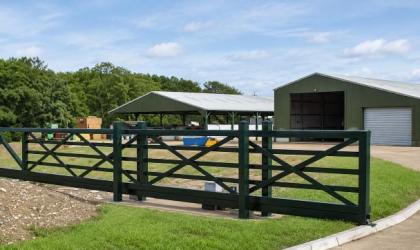


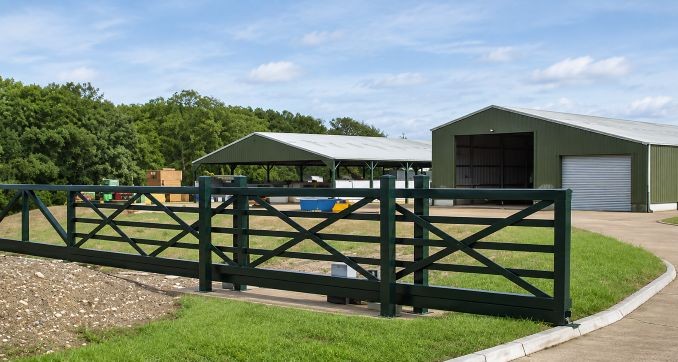
Agricultural Images
NFU Mutual estimates that rural crime cost the UK £41.5 million in 2025. This was 6% lower than the £44.1 million reported for 2024, but several important theft categories increased.
| NFU Mutual estimate | 2025 figure | Annual change |
|---|---|---|
| Total UK rural crime cost | £41.5m | Down 6% |
| Agricultural vehicle theft | £8.3m | Up 18% |
| Quad bike and ATV theft | £3.5m | Up 31% |
| Livestock theft | £4.5m | Up nearly 30% |
These figures are based on insurance claims data and do not represent every offence reported across the UK. They do, however, show why farms and rural businesses continue to invest in better control of vehicles, machinery compounds and site entrances.
An automated entrance should not be viewed as a standalone answer to rural crime. It is most effective when it forms part of a wider plan that includes secure boundaries, locked buildings, lighting, CCTV, alarms, key control and suitable protection for machinery.
Many rural sites have long driveways, limited natural surveillance and several potential access routes. At the same time, farms need to remain practical places to work. Staff, contractors, deliveries, livestock vehicles, customers and emergency services may all require access.
The objective is not to make normal work difficult. It is to ensure that unknown vehicles cannot simply drive onto the site unnoticed.
A well planned automated entrance can help you:
| ✓ Keep the entrance closed between authorised movements | ✓ Create a clear point at which visitors can be identified |
| ✓ Restrict access to known users, contractors and delivery drivers | ✓ Make it harder to remove vehicles, trailers or equipment without permission |
| ✓ Direct traffic through an area covered by cameras and lighting | ✓ Allow authorised users to operate the entrance from a house, office, reception point or mobile device |
| ✓ Create access records where a suitable managed access-control system is used |
Police rural-crime prevention guidance also recommends reducing unnecessary access points, establishing one controlled entrance where practical and combining physical security with lighting, CCTV and access control.
A gate alone cannot secure a site if a vehicle can bypass it through an open field entrance, weak fence line or unprotected verge. The surrounding boundary needs to support the entrance strategy.
There is no single “farm security gate” that suits every property. The correct solution depends on the opening width, site layout, traffic volume, vehicle sizes, ground levels, wind exposure, available power and the level of security required.
| Entrance system | Often suitable for | Points to consider |
|---|---|---|
| Automated swing gates | Farms, estates and lower traffic rural entrances | Require a clear swing area and must not open into public highway space |
| Automated sliding gates | Busy entrances and sites with limited swing room | Need secure side room for the gate to travel into when open |
| Cantilever sliding gates | Muddy, uneven or debris-prone entrances | Run above ground level, avoiding a track across the vehicle route |
| Bi-folding gates | Higher traffic sites where opening speed matters | Need careful safety and traffic-control design |
| Boom barriers | Visitor access, sales yards and traffic control | Useful for managing vehicles but not usually intended to resist deliberate vehicle impact |
| Rising bollards | Machinery compounds and higher-security entrances | Need suitable drainage, ground conditions and emergency operation |
| Road blockers and rising kerbs | Sites with a credible vehicle-impact threat | Require a risk-led specification, substantial civil works and clear operating procedures |
AGD Systems can advise on the practical choice between swing, sliding, cantilever and specialist layouts after reviewing the entrance, traffic movements and security priorities.
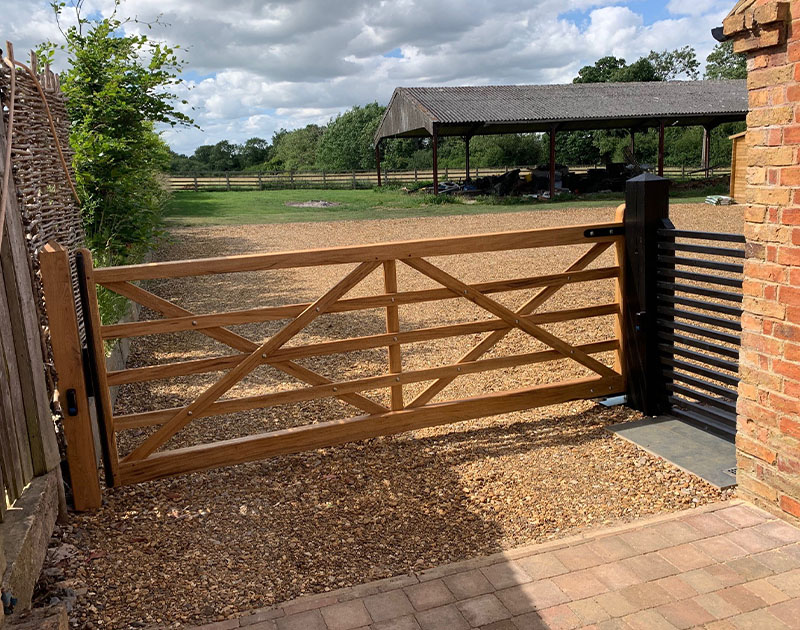
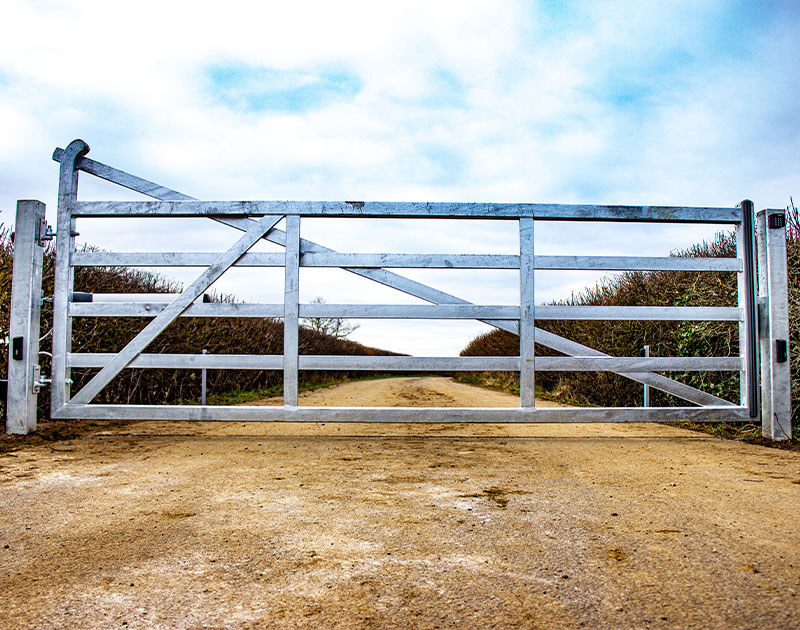
Both materials can work well for a rural electric gate. The important point is that the gate frame, posts, foundations, automation, safety equipment and access controls are designed as one complete system.

Steel is often chosen for wider openings, higher-security applications and entrances where a substantial physical presence is required. It can be made in open-bar, mesh, palisade-style or more solid designs and can be hot-dip galvanised before finishing for long-term protection.

Aluminium is a good option for rural homes, estates and customer-facing agricultural businesses where lower gate weight, corrosion resistance and appearance are priorities. It can provide a traditional boarded or five-bar look without the regular maintenance associated with timber.
The material alone does not determine security performance. A heavy steel gate is not automatically vehicle-impact resistant, and an aluminium gate should not be dismissed where the real requirement is controlled access, reliability and an attractive entrance.
An open gate design can reduce wind loading and maintain sightlines at the entrance. This can be valuable at exposed sites or where drivers need a clear view of traffic and pedestrians.
A solid or closely boarded design provides more privacy and can reduce the view of equipment from the road. It also catches more wind, which may mean stronger posts, deeper foundations and more carefully selected automation.
The best design balances privacy, visibility, structural loads, landscape appearance and the daily use of the entrance.
A conventional automated gate can provide an effective first layer of access control, but it should not be described as anti-ram simply because it looks heavy or is made from steel.
Where there is a credible risk of a deliberate vehicle attack, the entrance should be designed around the threat. This includes the likely vehicle, approach speed, angle of impact, available run-up, asset location and the distance an intruding vehicle could travel beyond the barrier.
Depending on the assessment, the solution may include:
✓ A gate with a secondary internal security line
✓ Rising security bollards
✓ A road blocker or rising kerb
✓ Tested vehicle-security barriers
✓ Protected gate posts and edge details to reduce bypass opportunities
✓ A separate secured compound for machinery, vehicles or stock
ISO 22343-1 is the current impact-testing standard for vehicle-security barriers. Any test rating should be read in full, including the vehicle type and mass, speed, impact angle, penetration result and installation arrangement. A tested product can perform very differently if it is installed outside the arrangement for which it was assessed.
Important: A standard boom barrier is primarily a traffic control product. It should not be relied upon as vehicle impact protection unless the exact model and installation have suitable independent test evidence.
The best access control system is one that keeps the entrance secure without encouraging people to leave it open for convenience.
A family farm with a small number of regular users needs a different arrangement from a dealership, livery yard or agricultural business receiving deliveries and customers throughout the day.
Suitable options may include:
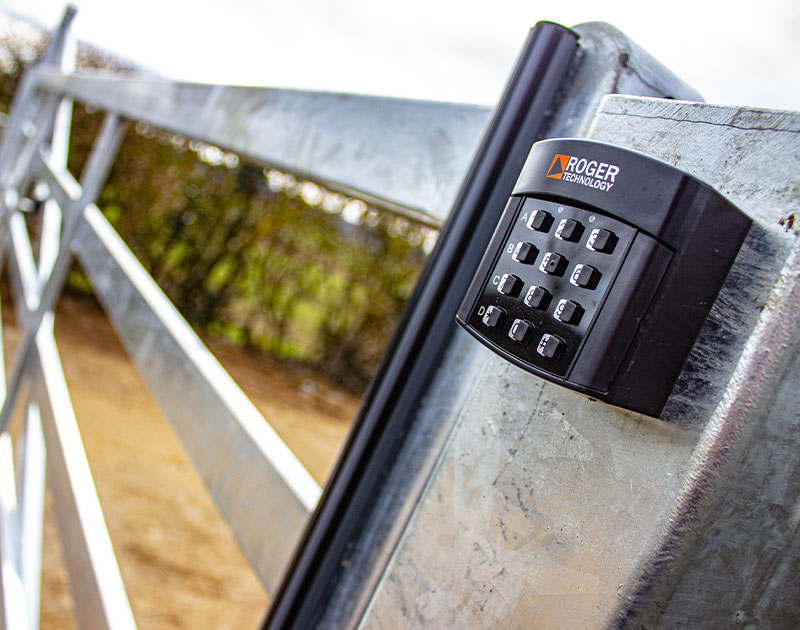
✓ Handheld radio transmitters for regular users
✓ Keypads with permanent, temporary or time-limited codes
✓ Proximity fobs and access cards that can be cancelled individually
✓ Telephone or smartphone-based gate operation where mobile coverage is reliable
✓ Audio and video intercoms linked to a farmhouse, office or reception
✓ Timed access schedules for staff, deliveries and trading hours
✓ Vehicle detectors for safe exit where security requirements allow
✓ ANPR for recognised vehicles and managed visitor access
✓ Integration with CCTV, alarms and security lighting
For an isolated farm, a camera intercom can allow the occupier to speak to and identify a visitor before opening the gate. For a busy agricultural sales premises, managed credentials and timed permissions can help separate staff access from customer, contractor and delivery traffic.
A reliable rural entrance needs to work in winter, in wet weather and during the busiest parts of the working day. It should be designed for the environment, not just how it looks when first installed.
The opening and approach need to accommodate the vehicles that genuinely use the site. This could include tractors with implements, telehandlers, combines, livestock trailers, low loaders, articulated delivery vehicles and emergency appliances.
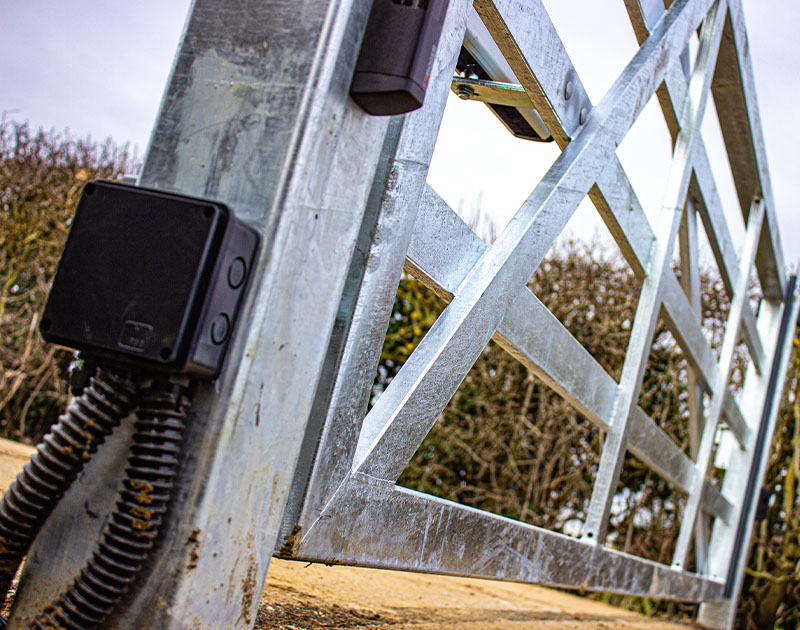
Posts, photocells, cabinets and safety equipment must be positioned where they are less likely to be struck by wide or overhanging loads.
Open countryside can create substantial wind loads. A solid gate behaves very differently from an open-bar, mesh or five-bar style gate. Gate size, structural stiffness, posts, hinges, operators and foundations must be considered together.
Tracked sliding gates need a clean, stable running surface. Where mud, stones, ice or yard debris are unavoidable, a cantilever sliding gate can be the more practical choice simply because it runs above the driveway surface and is unaffected by ground changes in various seasons and conditions.
Remote entrances may need a new electrical supply, ducting and communications connection. Battery backup, manual release and the required behaviour during a power failure should be agreed at the design stage.
Solar power can be effective in suitable locations, but performance depends on the gate size, operating frequency, available daylight, winter conditions and the safety equipment fitted to the system.
Posts, gate operators, rising bollards and road blockers depend on appropriate ground conditions and drainage. Underground services, water tables, frost exposure and surface water run-off should be assessed before excavation begins.
The safety assessment must consider everyone who might encounter the entrance. This can include staff, children, visitors, horse riders, cyclists, delivery drivers and livestock. A separate pedestrian entrance is often safer than mixing people with large agricultural vehicles at the same point.
Powered gates are machines, not simply manual gates with motors added. New automated gates, including existing manual gates converted to power operation, fall within the Supply of Machinery (Safety) Regulations 2008 when placed on the market or first put into service.
At workplaces and shared residential sites, owners, occupiers, landlords and managing agents have ongoing responsibilities for the safety of people who use or encounter the gate.
A professionally designed system should include a site-specific risk assessment and suitable protection against hazards such as crushing, drawing-in, shearing and impact. Depending on the gate and site layout, this can include:
✓ Monitored safety edges
✓ Photocells or light curtains
✓ Safe hinge arrangements
✓ Guarding around moving parts and sliding gate run back areas
✓ Vehicle detection equipment
✓ Warning signs and warning devices
✓ Correctly designed manual-release arrangements
✓ Suitable force limitation and safety controls
BS EN 12453:2017 and BS EN 12604:2017 are relevant standards for powered gates and barriers. However, HSE makes clear that compliance with standards alone may not always be enough to meet the applicable essential health and safety requirements. The completed entrance must be safe in its actual location and throughout its working life.
Agricultural entrances operate in demanding conditions. Regular inspection and servicing helps maintain reliability, security and the performance of safety-critical equipment.
Agricultural entrances operate in demanding conditions. Regular inspection and servicing helps maintain reliability, security and the performance of safety-critical equipment. A typical maintenance visit may cover gate alignment, hinges, rollers, guides and mechanical stops; foundations, posts, fixings and welds; locks, catches and anti-lift protection; safety edges, photocells, loops and other protective devices; and operators, drive systems, hydraulics and control panels. It may also include checking manual release and backup arrangements, drainage around below-ground equipment, corrosion, coating damage, vegetation and debris, as well as reviewing user permissions, lost fobs and redundant access credentials.
The appropriate service frequency will depend on the type of equipment, traffic level, location, environmental exposure and site risk assessment.
Planning requirements vary across the UK, so local advice should be sought where there is uncertainty.
In England, a gate, fence or wall will generally need planning permission if it exceeds one metre in height next to a highway used by vehicles, or two metres elsewhere. Additional restrictions can apply around listed buildings, within their curtilage, where permitted-development rights have been removed, or where other local planning controls apply.
The final design should also take account of:
✓ Safe visibility when leaving and entering the site
✓ Whether the gate opens inward and leaves enough vehicle waiting space
✓ Public rights of way
✓ Drainage and highway run-off
✓ Underground services
✓ Landlord, lender or estate-management approvals
✓ Emergency vehicle access
An entrance should never force a large vehicle to wait in an unsafe position on the public highway while access is authorised.
Why choose AGD Systems?AGD Systems has been specialising in electric gates, barriers and access control since 1986. From our Wellingborough base, we provide site surveys, bespoke gate design, installation, commissioning, servicing and aftercare for domestic, commercial, industrial and agricultural entrances. For rural properties and agricultural businesses, we look at the whole entrance rather than simply adding automation to a gate. That means considering traffic movements, vehicle sizes, access control, safety, ground conditions, future maintenance and the level of physical protection required. AGD Systems can assist with:✓ Bespoke steel and aluminium automated gates ✓ Swing, sliding, cantilever and specialist gate layouts ✓ Traditional farm-style gates and commercial security gates ✓ Automatic barriers for traffic management ✓ Video intercoms, keypads, fobs, transmitters and managed access control ✓ Rising security bollards ✓ Road blockers and rising kerbs ✓ Rural perimeter-security planning ✓ Servicing, repairs and long-term maintenance |
No single product can guarantee that theft will be prevented. A well designed electric gate can deter unauthorised entry, make opportunist drive in theft more difficult and provide useful control over who enters and leaves the site. It works best alongside secure boundaries, cameras, lighting, alarms, locked storage and independent protection for machinery and vehicles.
No. The material and visual weight of a gate do not prove how it will perform during a vehicle impact. Where vehicle impact is a credible risk, the complete system, including foundations and installation method, should be selected against a defined threat and supported by relevant independent test evidence.
Yes, where the main requirement is to manage frequent authorised vehicle movements at a sales yard, visitor entrance or internal checkpoint. A standard boom barrier is a traffic-control product rather than a high-security barrier, so a gate, bollards or a road blocker may be needed where forced entry is a concern.
It depends on the opening width, local wind conditions, ground levels, space available and expected traffic. Open infill can reduce wind load, while sliding or cantilever systems can be useful where there is no safe swing area. A survey allows the gate design, posts, foundations and automation to be matched properly to the site.
Sometimes. The existing gate, posts, hinges, stops, structural condition and safety risks all need to be assessed first. Once automated, the gate becomes machinery and the completed installation must meet the relevant product safety requirements.
The system should have an agreed arrangement for manual release or backup operation. The appropriate response depends on security, emergency access, fire procedures and day-to-day operation, so it should be specified before installation.
Yes. Suitable access-control systems can issue individual fobs, cards, codes, telephone permissions or vehicle credentials. Permissions can be limited by person, entrance, time or day, which is useful for staff, contractors, customers, tenants and seasonal workers.
Yes. Routine servicing supports safe operation, reliability and long-term security. The right maintenance interval depends on the gate type, usage, environmental conditions, manufacturer guidance and site risk assessment.
Every farm, estate and agricultural business has different traffic patterns, entrance layouts and security priorities. AGD Systems can assess the opening, expected vehicles, ground conditions, exposure, access requirements and required level of protection before recommending an appropriate electric gate, barrier or vehicle-security solution.
Call AGD Systems on 01933 229123 or email enquiries@agdsystems.co.uk to discuss an automated entrance for your farm, agricultural premises or rural property.
